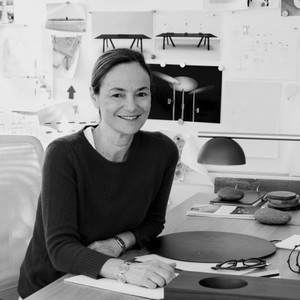
Since the 1980s Arthur Casas has become one of the most prolific and innovative architects to come out of Brazil. Casas has working studios in both Sao Paulo and New York with work spreading from Paris, Rio de Janeiro, Tokyo to Buenos Aires, and more.
Sao Paulo, Arthur Casas' birthplace, has instilled in him his cosmopolitan spirit and the will to look outwards and embrace the design world. This ethos can be seen within Casas' work, which is defined by his indistinguishable and ever-changing designs. As an architect, Casas was unique in his indifference to define and classify, which resulted in him constantly evolving his architectural and design style.
Casas believes architecture and household design are inextricably linked. Casas can only see the meaning of the spaces he designs if he can comprehend the furniture that was designed or chosen for them. Casas is an artisanal craftsman with his furniture designs suppressing all unnecessary details. His designs move towards nature and handicraft pieces and away from industrialization. He brings forward the mid-century modern aesthetic, while referencing the rich Brazilian wood making tradition. This results in unique and contemporary pieces of furniture full of character while still adhering to a strong ethical standpoint.
Sergio Rodrigues was a pioneering Brazilian architect and designer, celebrated as the "father of modern Brazilian furniture." His work fused traditional craftsmanship with a distinctly Brazilian identity, combining noble woods, natural leather, and generous, organic forms.
Rodrigues gained international recognition with iconic pieces like the Mole Armchair (1957), a symbol of relaxed Brazilian modernism that won the top prize at the IV International Furniture Competition in Italy. Throughout his career, he designed hundreds of pieces-chairs, sofas, tables-that embodied comfort, informality, and authenticity. Deeply rooted in Brazil's culture and landscape, Rodrigues believed that design should be both functional and joyful. His timeless creations continue to define contemporary interiors worldwide, blending sophistication with warmth, and making him one of the most influential figures in 20th-century furniture design.
Carlos Motta, one of the leading Brazilian architects, personally executes every step and details of his creations. He is constantly involved with environmental conservation projects and chooses sustainable sources to create his pieces. His designs use ecologically certified or reclaimed wood, resulting in strong, durable, elegant pieces. Motta is passionate about Brazil, especially the country's natural beauty.
Motta graduated with a degree in architecture in São Paulo, 1976. He worked as a designer and cabinetmaker in Santa Cruz, California, while attending classes in building techniques at Cabrillo College. Later, Motta studied and did research Finland on molded and rolled wood. Carlos has participated in numerous exhibitions in Brazil and abroad, including Brazil Faz Design, in Milan, Italy; International Biennial of Design, in Saint Etienne, France; and Object Brazil - 500 Years of Design, at Pinacoteca do Estado de São Paulo, Brazil. He has been awarded many important prizes, most notably the Hors Concours Award at the IX Prêmio do Museu da Casa Brasileira; First Place, Aluizio Magalhães Prize, at the V Competition of Industrial Design; and First Place, Best Furniture Design, at II Prêmio do Museu da Casa Brasileira. Motta is a professor of Planning at FAAP University in São Paulo.
Claudia Moreira Salles graduated in 1978 at the Escola Superior de Desenho Industrial (ESDI) in Rio de Janeiro.
After working at the Design Institute of Rio's Museum of Modern Art, in a furniture project for public schools , she moved to São Paulo to become part of the design team of Escriba, a furniture company. At the same time she started developing more authorial projects relying on craftworks, especially in wood. These first pieces, including the desk Canguru reedited in a new version in 2016 by Espasso, were showed by Fulvio Nanni who during the 1980s represented an independent generation of designers and their production.
Later she met Etel Carmona who had just started her own furniture manufacturing company dedicated to restore traditional woodworking techniques and to whom Claudia starts creating furniture allying the simplicity and rationality of an industrial product with the richness of Brazilian native woods and the skills of the woodworkers.
Claudia values working close to the craftspeople and following every detail of the production. To counteract with wood she started exploring other materials like cast concrete, stone, steel, copper and niobium. She extended her collaboration creating furniture to other brands like Casa 21, Firma Casa, Dpot and Butzke and diversified designing objects and lighting for St. James, specialized in silverware; Bertolucci and Lumini both lighting companies.
Since 2002 she is represented by Espasso with pieces made in Brazil and in the US.
Born in Rio de Janeiro, Zanini de Zanine is a celebrated Brazilian designer, deeply rooted in a legacy of craftsmanship through his father, José Zanine Caldas. After graduating in Industrial Design from PUC-Rio in 2002, he apprenticed under Sergio Rodrigues. Starting in 2003, Zanini developed his "Contemporary Carpentry" line using salvaged wood-beams, posts, and other elements from old houses. By 2005, he expanded into industrial furniture production, incorporating controlled-origin wood and materials such as plastics, acrylic, metals, and recycled industrial components. In 2011, he founded Studio Zanini, collaborating with international brands like Cappellini, Poltrona Frau, Slamp, Tolix, and Espasso. In 2015 he was named Designer of the Year at Maison & Objet Americas, and has received multiple Brazilian and international awards including IDEA Brasil, IF Design Award, and the Design Excellence Award from the Philadelphia Museum of Art.